Leopard Print Rayon Wholesale: Color Variants, MOQ & Buyer Notes
Leopard print rayon at wholesale: color families, base GSM, rotary vs digital tradeoffs, and what Brazilian, US, and Middle East buyers actually order.
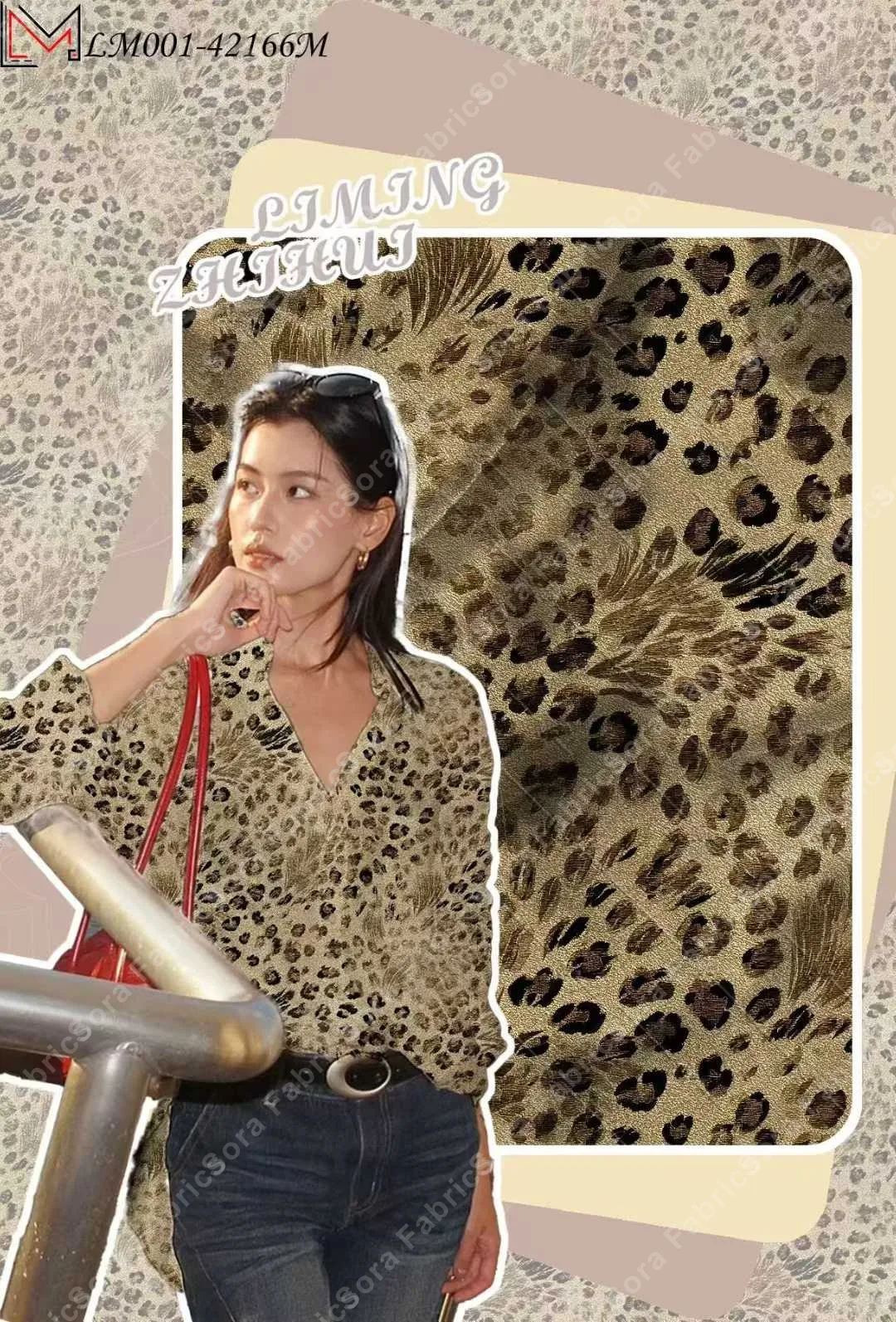
A São Paulo dress brand pings us asking about tecido de oncinha. A Dallas resort label calls it leopard print rayon. A Riyadh abaya wholesaler writes قماش جلد النمر. Three buyers, same week, same fabric — and three different conversations about color, scale, and what the print is supposed to do on the body.
We run a printing mill near Guangzhou that produces leopard-print rayon as one of our top three repeat-order patterns. This guide is the conversation we have with new leopard buyers on the first call: which color family ships to which market, what GSM holds the print without looking cheap, and where the MOQ numbers really sit once you stop talking to brokers.
Why leopard sits in a different category than other ethnic prints
Leopard is a wardrobe-staple print, not a trend print. That single fact changes how the wholesale math works.
A trend motif — say a current-season tropical floral — has a 4-6 month sell-through window. After that, the rolls sit. Leopard does not have that problem. The pattern has been in retail circulation since the 1960s and the demand curve barely flexes between spring and fall collections. Buyers who order leopard tend to reorder the same colorway 2-4 times a year, sometimes for 3+ years on the same artwork.
For a wholesale mill that translates into two operating differences:
- We keep deeper ready stock on leopard than on trend prints. A trend ikat might sit at 200-300 m per colorway. A leopard colorway sits at 500-800 m because we know it will move.
- The rotary screen cost amortizes faster. Spending $400-600 to engrave a new leopard artwork is rational at 600 m total volume; for a trend print you’d want 1,000 m+ before justifying screens.
Both of these flow through into your unit cost. Leopard is one of the few prints where the 150 m first order is genuinely competitive with the 1,000 m reorder on per-meter price, because we are not amortizing setup against your single PO.
The five leopard color families (and which sells where)
“Leopard print” is shorthand for a family of related artworks, not a single design. Buyers who order without specifying the color family end up with the wrong product about half the time. The five families that cover ~95% of wholesale demand:
1. Natural tan and chocolate
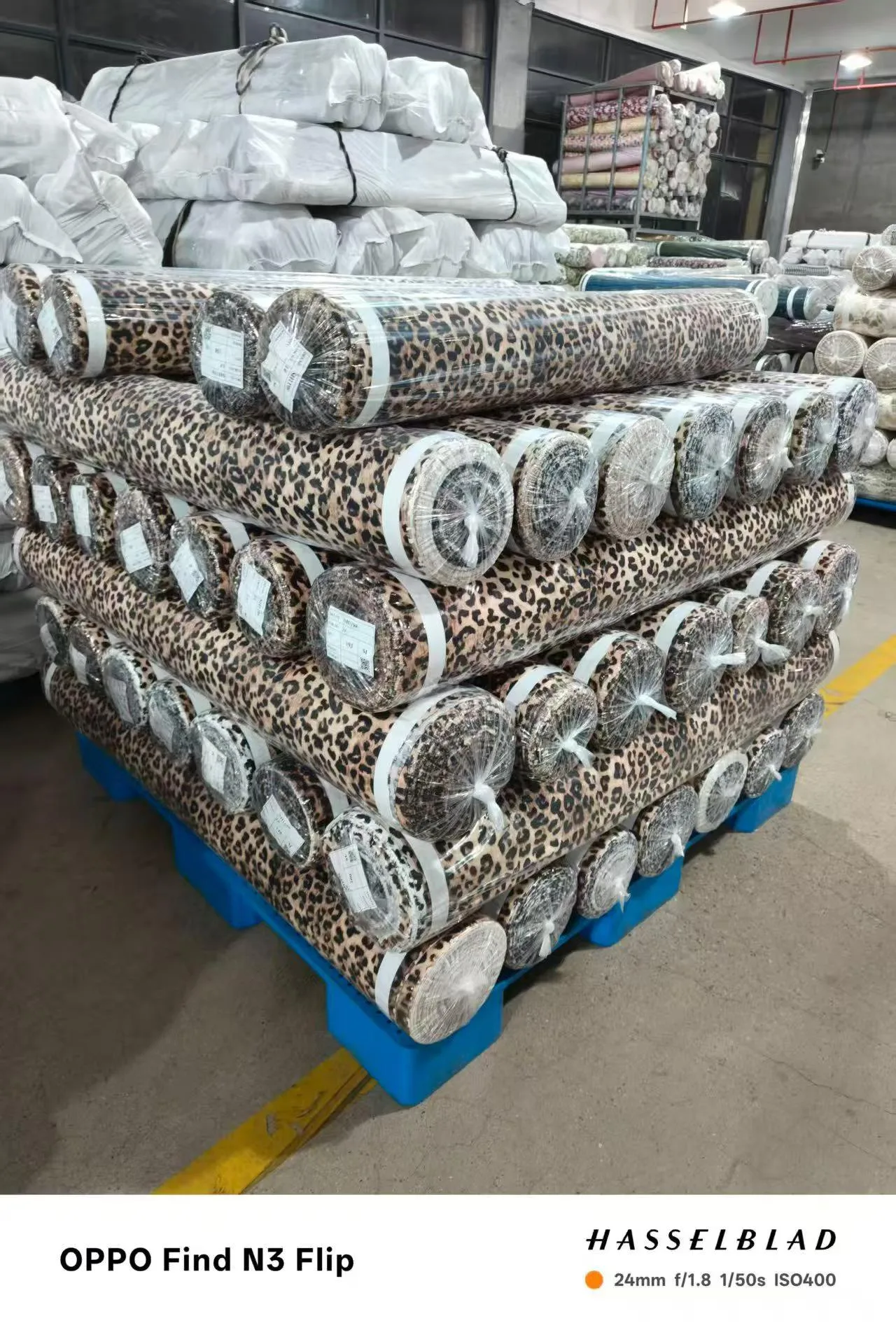
Warm beige base, brown spots, occasional cream highlights. The “classic” leopard most buyers picture when they say the word.
Sells to: US mainstream wholesale, European resort wear, Middle East abaya linings (the warm tone reads as luxe under sheer overlays), São Paulo medium-tier brands. Year-round demand, slight spring/fall peak.
Watch-out: Stay near the natural color reference. Pushing the tan too yellow turns the print into “giraffe-adjacent” and the cohort returns it.
2. Black and white (snow leopard)
White or pale grey base, black spots, sometimes with a hint of silver in the spot shadow. Crisp, graphic, gender-neutral.
Sells to: Streetwear collaborations, men’s shirting capsules, kids’ wear (parents read black-and-white as less “adult”), Japanese minimalist labels.
Watch-out: Black-and-white leopard washes out on rayon at < 110 GSM because the contrast crushes the soft hand. Push to 130 GSM minimum on this family.
3. Saturated color leopard (red, magenta, emerald base)
Spot pattern in classic black or brown, but base color swapped to a saturated shade. The “fashion-forward” tier.
Sells to: Festival wear brands, US bohemian-resort labels, Brazilian estampa de oncinha colorida segment, indie LA designers. Lower volume per order but consistent restocks because it stands out on Instagram and TikTok product pages.
Watch-out: The saturated base eats some of the contrast, so spot scale should be 15-20% larger than on the natural-tan family to keep the leopard read.
4. Subtle / micro leopard
Small-scale spots, low contrast, often in a tonal palette where spot and base are within 2-3 shades of each other. Reads more as texture than as pattern at 2 meters’ distance.
Sells to: Premium resort wear (Italian Riviera labels), silk-substitute wholesale, scarf and accessory makers. The micro scale lets the print pair with stronger garment construction without competing.
Watch-out: Digital printing handles micro leopard better than rotary — the spot edge is too fine for screen at small scale. Default to digital here.
5. Cheetah / panther variants
Not strictly leopard but ordered under the same buyer search. Cheetah uses solid spots without the rosette ring; panther is a near-black tonal version. Both ship from the same animal-print category in most wholesale catalogs.
Sells to: African market (Lagos, Accra) — cheetah-style runs especially strong in Nigerian ready-to-wear. Solid-spot variants also outsell rosette leopard in Cambodia and Vietnam.
Watch-out: Confirm “cheetah” vs “leopard” in writing. Buyers from English-speaking markets use the words interchangeably; African buyers usually mean cheetah specifically.
We stock all five families as ready-stock rayon at 150 m MOQ. See our leopard print collection for current colorways. If you need a specific variant we don’t carry, custom digital print starts at 100 m and rotary at 300 m.
Printing method: rotary vs digital for leopard
Leopard sits in the rotary screen sweet spot more cleanly than most prints. The reasons:
- The motif uses 4-6 colors typically (base + 2-3 spot tones + occasional highlight). Rotary handles this without engraving cost ballooning.
- The pattern repeats are large enough (30-50 cm typical) that rotary screens stay within manageable diameter.
- Bestsellers reorder for years, so screen amortization pays back fast.
Rotary wins when:
- Order is ≥ 250 m on a single colorway
- You plan to reorder the same artwork within 12 months
- Per-meter cost is the dominant constraint
Digital wins when:
- You’re testing 4-5 colorway variants at 50-100 m each
- The leopard is micro-scale (family #4 above) or uses photo-realistic shading
- You need samples in 10-14 days for a buying trip
For the full cost crossover math on rotary vs digital, see Digital vs Rotary Screen Printing for Low MOQ Orders. For leopard specifically the crossover sits around 220-280 m at 5 colors. Below 200 m, digital is cheaper. Above 300 m, rotary wins on per-meter by 30-50%.
Base fabric: GSM and fiber for leopard print
The motif is half the order. The base fabric determines whether the finished garment drapes like a dress someone will pay $180 for or like a $35 fast-fashion piece.
| Base | Weight | Best for | Per-meter cost (printed leopard) |
|---|---|---|---|
| Rayon (viscose) 100% | 100-110 GSM | Flowy dresses, scarves, lining for abayas | $0.90-1.10 |
| Rayon (viscose) 100% | 120-130 GSM | Wrap dresses, blouses, men’s shirting | $1.00-1.20 |
| Rayon-linen blend (85/15) | 130-160 GSM | Resort wear, structured tops, light jackets | $1.30-1.70 |
| Cotton poplin | 100-120 GSM | Children’s wear, summer shirting, kid-safe markets | $1.50-1.90 |
Rayon is the workhorse — about 80% of wholesale leopard ships on rayon. The fiber takes the leopard color palette better than cotton because rayon absorbs dye more deeply, producing the warm saturated tones that read as “luxe” rather than “cheap costume”. On crisp cotton the same artwork can read flat.
For abaya wholesalers specifically: the 100-110 GSM rayon is the sweet spot. Heavier weights add bulk under the outer abaya layer, lighter weights show through. We have shipped this weight-and-print combination repeatedly to Saudi and UAE buyers — confirm GSM in writing before bulk.
For GSM selection in general, see What Does Fabric GSM Mean. For the fiber-vs-fiber comparison between rayon, lyocell, and modal, see Lyocell vs Modal vs Rayon.
MOQ ladder and pricing reality
What buyers actually pay for leopard-print rayon, FOB Guangzhou, current 2026 pricing:
| Order size | Method | Per-meter price | Lead time |
|---|---|---|---|
| 150-200 m (ready stock, our colorway) | Pre-printed inventory | $0.95-1.15 | 5-7 days |
| 100-150 m (your colorway, digital) | Digital print on demand | $2.10-2.70 | 10-14 days |
| 300-500 m (your colorway, rotary) | Rotary screen, 4-6 colors | $1.00-1.25 | 25-32 days |
| 1,000+ m (your colorway, rotary reorder) | Rotary, screens amortized | $0.80-1.00 | 20-26 days |
| Sample cut (any colorway) | 2-3 m for inspection | $15-30 flat | 3-5 days |
The ready-stock tier is where most first leopard orders land. Pick a colorway from our standing inventory, take 150 m at $0.95-1.15, get the fabric in hand and see how your customer responds before committing to a custom-print run. From order #2 onward, custom artwork becomes worth the setup once you know which color family converts in your channel.
For the broader supplier-screening checklist before placing any wholesale fabric order, see Low MOQ Fabric Sourcing for Indie Fashion Brands.
Pre-order checklist for leopard-print rayon
Six items to confirm in writing before the PO. Most leopard returns trace back to one of these not being addressed upfront:
- Color family confirmed by reference. Send a swatch photo or a Pantone reference. “Leopard print” without a color cue lands wrong about 40% of the time.
- Spot scale matched to garment. Micro spots disappear on a wide-leg trouser at 2 meters; large spots overwhelm a children’s blouse. Specify spot diameter in centimeters or send a garment mockup.
- GSM matched to use case. 100-110 GSM for abayas and flowy dresses, 120-130 GSM for wrap dresses and shirting, 150+ GSM for jackets and resort structured pieces.
- Print method noted on PO. Write “rotary” or “digital” explicitly so the mill cannot quietly substitute the cheaper method on a marginal order.
- Sample cut approved before bulk. 2-3 meters is enough to check color accuracy and hand feel. Skip this and you risk 150-500 m of fabric that does not match what you imagined.
- Wash test in writing. Leopard colors should hold through 15+ machine washes without fading the spot edge. Reactive dye holds better than pigment for repeat washing — see Reactive vs Pigment Printing for the chemistry behind the choice.
Regional terminology and what to put in your PO
Leopard print is one of the few patterns where buyer-side terminology actively misroutes orders. The mill sees the same fabric under five names every week:
| Buyer market | Term used | What they usually mean |
|---|---|---|
| US / UK | Leopard print | Natural tan + brown rosette spots |
| Brazil / Portugal | Estampa de oncinha | Same as above, occasionally bolder color base |
| Spain / Mexico | Estampa de leopardo / animal print | Natural tan family, sometimes saturated variants |
| France | Imprimé léopard / motif léopard | Same range, slight preference for tonal-low-contrast |
| Saudi / UAE | قماش جلد النمر / leopard print | Natural tan, lightweight rayon for abaya linings |
| Nigeria / Ghana | Cheetah print or leopard | Cheetah-style solid spots ship more than rosette |
If you are sourcing in a non-English buyer market, put the English term + your local market term both on the PO. That single line removes the most common cause of color-family mismatch on leopard orders.
Where leopard fits in a 2026 collection
Leopard is in three places right now that wholesale buyers are quietly stocking deeper:
- Men’s shirting capsules — the black-and-white family (#2 above) is showing up in indie men’s brands as a button-up shirt or short-sleeve camp shirt. Different cut, same fabric.
- Abaya inner linings — the natural tan family on 100 GSM rayon ships in growing volume to Gulf wholesalers as the visible inner layer under a sheer outer abaya. Color is luxe-readable, weight does not add bulk.
- Kids’ resort wear — micro leopard on cotton poplin runs strong for ages 4-10 in spring/summer drops. Kid-safe fiber + a print that reads as fun without being childish.
Leopard is also the rare wholesale fabric where the buyer-side conversation tends to be shorter than for trend prints. The customer already knows the look. The mill side is mostly about matching the color family and spec’ing GSM correctly — the rest of the order moves quickly.
Get a leopard quote routed
Send us your reference image, target MOQ, and intended end-use at Sorafabrics on WhatsApp. We will identify the color family, recommend rotary vs digital for your order size, and quote both the ready-stock and custom-print options side by side. Or browse our leopard print ready stock if you want to start from a finished colorway at 150 m MOQ — typically the fastest path from PO to shipped roll.
For sourcing context beyond leopard, see How to Import Printed Fabric from China for the freight and customs side, and Ikat Motif Wholesale Fabric if you want to see the same buyer-guide treatment for a pattern family on the opposite end of the trend cycle.